
Most leaders say they want “knowledge” in their organization.
But what they really have is people who remember things.
If your team’s work isn’t documented — if the thinking, decisions, and lessons learned only live in someone’s head — you’re renting knowledge that walks out the door every time they do.
And when that person retires or gets poached, so does your IP.
The Illusion of Institutional Knowledge
Every medical device company has “that person.”
You know the one. They’ve been doing that critical thing for 20 or 30 years. They’re the only ones who really understand how the system works. When something breaks, everyone turns to them. When a new hire needs training, they’re the go-to mentor.
They’re brilliant. Dedicated. Reliable.
And they’re also your biggest single point of failure.
Last week, I watched a medical device startup scramble when their “irreplaceable” mechanical engineer — the only one who understood their catheter delivery system — announced retirement. Six months from 510(k) submission, and suddenly no one knew the rationale behind critical design decisions.
When everything depends on individual memory instead of shared understanding, you don’t have institutional knowledge — you have institutional risk.
Why Documentation Matters Even More in Medical Devices
If you’re in medical device product development, when I say “documentation,” you’re probably thinking compliance:
- Design History File (DHF)
- Device Master Record (DMR)
- Design Controls
- Risk Management File (ISO 14971)
- Verification and Validation protocols
- 510(k) submissions
That’s not what I’m talking about.
Those are outputs. Artifacts. The stuff you compile at the end to check regulatory boxes.
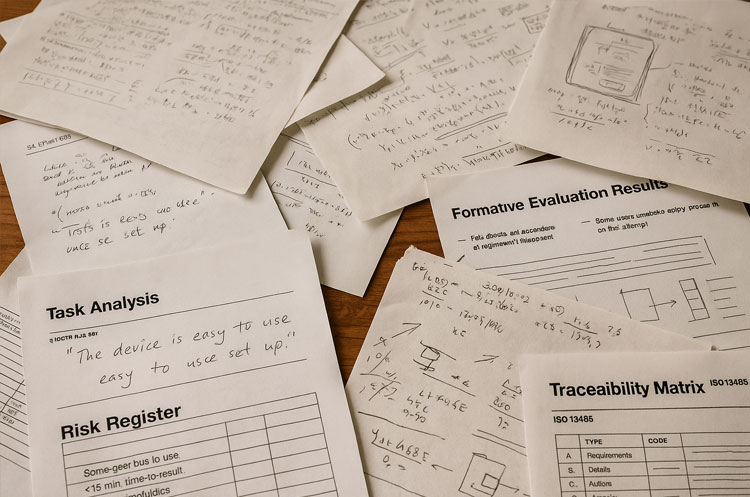
I’m talking about documentation as a thinking tool. Documentation that happens in the moment, as you work. Documentation that makes your medical device design process smarter, faster, and more innovative.
Here’s the difference:
Compliance documentation asks: “Can we prove we followed the process?”
Thinking documentation asks: “Why did we make this choice? What did we learn? What would we do differently?”
Compliance documentation is written for auditors.
Thinking documentation is written for your future self and your teammates.
Compliance documentation happens at milestones.
Thinking documentation happens daily.
The irony? When you get thinking documentation right, FDA regulatory compliance practically writes itself. Your DHF becomes a natural byproduct of doing great work — not a scramble before FDA submission.
But more importantly, thinking documentation:
- Prevents you from solving the same problem three times
- Helps new engineers understand the “why” behind design decisions
- Captures the failed experiments that teach you what not to do
- Builds institutional memory that survives employee turnover
- Creates a knowledge base that makes your next product better
The best medical device companies understand this distinction.
They don’t just document for the FDA — they document to think better, collaborate better, and innovate faster.
Compliance keeps you in business. Thinking documentation helps you win.
The Hidden Barrier to AI (and Scale)
Everyone’s racing to “leverage AI” right now.
But here’s the uncomfortable truth:
If your medical device development process hasn’t documented its thought process, your AI strategy is dead on arrival.
AI can’t learn from tribal knowledge.
It can’t infer context that was never written down.
It can’t improve decisions it doesn’t understand.
You want to train AI on your design processes? Great. Where are they?
You want AI to help with risk analysis? Wonderful. What’s the baseline?
You want AI to accelerate regulatory submissions? Fantastic. What patterns exist?
If there’s nothing written, there’s nothing to learn from. No context. No training data. Just a bunch of know-how locked behind human bandwidth.
But even before AI comes into play, documentation has another superpower — it makes humans think better.
Writing Is Thinking
When you write out your reasoning — when you try to explain how and why you made a design decision — you’re not just recording knowledge; you’re refining it.
The simple act of writing:
- Clarifies thought — fuzzy ideas become concrete when you have to explain them
- Exposes gaps in logic — you can’t hand-wave past problems on paper
- Sharpens communication — if you can write it clearly, you can explain it clearly
- Improves collaboration — written ideas can be shared, critiqued, and built upon
- Strengthens collective intelligence — everyone can learn from everyone else’s thinking
It’s not a chore — it’s a thinking tool.
Good documentation isn’t just for others. It’s for you, in the act of learning, designing, or solving.
The process of documenting makes you better at the work itself.
For Medical Device Founders
Your DHF shouldn’t be a dead document created for FDA submission. It should be a living knowledge base that:
- Accelerates new engineer onboarding
- Prevents repeated design mistakes
- Speeds up next-generation product development
- Makes regulatory submissions smoother
- Protects your IP when key people leave
Why We Made Documentation Part of the Work
Early in my consulting career, prospective clients would say:
“We don’t want to outsource medical device engineering — we’ll lose our internal knowledge.”
That didn’t sit right with me.
Why should working with a partner mean giving up the learning? Why couldn’t collaboration make both sides smarter?
So we made it part of our mission: to document our thinking better than anyone else.
Clients shouldn’t just get a product — they should inherit the reasoning that built it. The “why” behind every “what.” The trade-offs considered. The paths not taken. The lessons learned along the way.
And the results speak for themselves — over the past seven years, we’ve maintained a Net Promoter Score of 82.
That’s world-class by any standard. And it’s not because we deliver perfect products every time (nobody does). It’s because our medical device clients walk away smarter. They understand not just what we built, but how to think about their next challenge.
Documentation creates alignment. When clients can see our thinking in real time, there are no black boxes. No surprises. No “trust us, we’re the experts.” Just transparent, collaborative problem-solving that makes everyone better.
Today, after 30 years of refining this approach in hardware development documentation, documentation isn’t something we do after the work.
It is the work.
How We Do It at Inertia
1. Daily Stand-ups and "Dailies"
We start each day with a short, verbal check-in:
- What did you get done yesterday?
- What are you working on today?
- Any roadblocks?
But we don’t stop there.
Each team member also posts a brief written “daily” — 5–10 lines capturing activities, accomplishments, and challenges — in the project Slack or Teams channel.
They back it up with visuals: sketches, screenshots, CAD captures, test results, or prototype photos, often organized in Miro boards or PowerPoint decks that evolve throughout the project.
This creates a living, visual log of progress — a digital trail of learning and iteration that anyone can follow, even months later. For medical device projects, it becomes invaluable during design reviews and FDA audits.
2. Decision Trees
Complex problems deserve structure.
We use decision trees to track and visualize how we navigate multi-variable challenges. Each branch captures:
- The options considered
- The criteria used to evaluate them
- The tests or analyses performed
- The rationale for the path chosen
For medical device clients, these decision trees feed naturally into their Design History File (DHF). When the FDA asks, “Why did you choose this material?” or “How did you determine this safety margin?” — the answer is documented, traceable, and defensible.
This isn’t bureaucracy — it’s insurance. It prevents rework (“Why did we rule out Option B again?”), reinforces accountability, and turns gut calls into reusable knowledge.
More importantly, it teaches clients how we think. They don’t just see the final recommendation; they understand the journey that got us there.
3. Weekly Project Updates
Every project follows a consistent structure:
- Top three accomplishments from last week (done / not done)
- Top three priorities for next week
- Current challenges (technical, resource, or strategic)
- Risk registry (what could go wrong and how we’re mitigating it)
- Scope change log (because scope always changes)
- Weekly action item log (including decisions made)
- Technical and project content (the meat of the update)
This format creates a rhythm of reflection — a written heartbeat of the project. It forces teams to step back, assess, and articulate progress beyond “we’re working on it.”
Medical device clients tell us these updates make ISO 13485 audits smoother because the documentation already exists in a clear, traceable format. Many even adopt our formats for their own internal projects.
4. Design Reviews
- The design intent
- Key assumptions and constraints
- Feedback received (verbatim when possible)
- Actions taken in response
- Rationale for changes (or for not changing)
Leaders Set the Tone
The biggest mistake medical device leaders make is assuming documentation will “just happen.”
It won’t.
People are busy. Deadlines are tight. FDA submissions loom. Documentation feels like overhead when you’re racing to ship.
That’s why leaders have to:
- Demand it — make documentation a deliverable, not a nice-to-have
- Make space for it — build documentation time into project schedules
- Reward it — recognize and promote people who document well
- Model it — document your own thinking and decisions visibly
Treat documentation as an output, not an afterthought.
Because without it, your team’s brilliance leaves the building at 5 p.m. every day.
The Payoff
When you build documentation into the way you work in medical device engineering, something powerful happens:
Onboarding gets faster. New engineers understand the medical device design process from day one.
FDA submissions get smoother. Your DHF is already complete because you documented as you went.
Design decisions get smarter. Teams build on previous learning instead of reinventing wheels.
Risk management improves. Patterns emerge from documented failures and near-misses.
Teams learn from each other. Best practices spread. Mistakes don’t repeat.
Thought becomes clearer. The discipline of writing sharpens thinking across the board.
Communication gets stronger. When people practice explaining their work, they get better at it.
Client relationships deepen. Transparency builds trust. Understanding builds loyalty. Our NPS of 82 proves it.
And when AI finally enters the picture, it has something real to learn from — not just data, but context, reasoning, and wisdom.
Documentation isn’t bureaucracy.
- It’s a feedback loop for better thinking.
- It’s how individual intelligence becomes organizational intelligence.
- It’s how good client relationships become great ones.
- It’s how medical device startups become medical device leaders.
How to Start: Two Simple Actions
Ready to build a culture of documentation in your hardware startup? Start here:
1. The Daily Question
At the end of each day, have everyone answer:
“What’s one thing I learned today that someone else should know?”
Post it in a shared channel. Make it a ritual.
This simple practice creates a living knowledge base and gets your team comfortable documenting insights as they happen.
2. Weekly Reports to Management
Use the weekly project update format above and have your teams present it to management.
This forces reflection, gives leadership visibility, and creates a written record of progress and decisions that becomes invaluable months later.
Start small. Be consistent. Watch knowledge compound.
Because the most valuable work your team does this week might never leave the page — unless you make sure it does.
Because in the end, what you document isn’t just your work — it’s your wisdom.
About the Author: Ray Minato is the founder and CEO of Inertia, a medical device product design and manufacturing service firm that has helped well over 100 startups and established companies bring innovative medical devices to market. With 30 years of experience in hardware development and FDA regulatory navigation, Ray specializes in turning complex medical device challenges into market-ready solutions. Connect with Ray on LinkedIn to learn more about accelerating your medical device development process.


