

1. The Real Differentiator Isn't Problem-Solving-It's the Experience
“I thought hiring an external innovation services firm would make our lives easier. Instead, we spent more time managing them than doing the work ourselves.”
We’ve heard variations of this countless times, not because the teams weren’t smart or technically capable, but because the experience of working with them fell short.
In the world of product strategy, design, engineering, and manufacturing, most firms lead with their technical chops.
They talk about how their team solves complex problems, their depth of services, their engineering prowess, and their track record of delivering innovation.
And yes, those things absolutely matter.
You wouldn’t hire a real-estate lawyer to defend you at a murder trial. Competence is the minimum requirement.
But that’s not what separates the good from the great.
What often gets overlooked is the experience of working together; the clarity, the communication, the sense of trust and momentum.
The confidence that your team is in sync, your risks are visible, and your time is respected.
That’s where most professional service firms fall short.
And that’s where the real opportunity lies.
Delivering world-class customer experience across strategy, engineering, and manufacturing isn’t about saying the right things – it’s about doing the right things, consistently, at every step.
2. Proof Over Promises: 5 Years of Measured Experience
One of the most effective ways to prove you’re delivering exceptional service is to measure it systematically and honestly.
Over the past six years, we’ve conducted more than 50 structured interviews with clients at major project milestones using the Net Promoter Score (NPS) framework. Developed by Bain & Company, NPS is a globally recognized method for assessing customer loyalty. It’s based on a single question:
“On a scale of 0 to 10, how likely are you to recommend us to a colleague or peer?” Respondents are grouped as:
- Promoters (9–10)
- Passives (7–8)
- Detractors (0–6)
The score is calculated by subtracting the percentage of detractors from the percentage of promoters.
Our cumulative score over this five-year period is 79—a rating that, according to Bain & Company, is considered world-class for most industries.
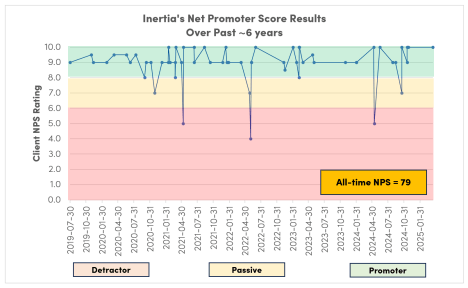
Next time you speak with a technical service provider, ask them what their NPS score is—or any customer satisfaction score, for that matter. You might be surprised how few can give you an answer.
When was the last time your team asked clients how they really felt—and was ready to act on the answer?
3. Culture First: The Foundation of Everything We Do
We’ve spent years intentionally building a world-class culture, not just because it makes for a great workplace, but because it’s the most important ingredient in delivering value to clients.
We operate transparently. We share openly about ideas, trade-offs, risks, and concerns – and we extend that same openness to our clients.
Transparency builds trust
And when trust is present:
- Collaboration gets easier
- Feedback becomes faster and more constructive
- Innovation gets supercharged
Harvard Business Review notes that transparent teams move faster, make better decisions, and build stronger relationships.
We’ve seen that firsthand. It’s a strategic advantage, not a soft skill.
Trust isn’t just a vibe. It’s a lever. When it’s built into the way you work, it accelerates everything.
How deliberately has your team designed its culture? And is it helping or hindering client relationships?
4. What World-Class Means in Practice
What does “world-class” actually mean in the context of innovation, design, engineering, and manufacturing?
It means clients not only love the outcome, they love the experience. They feel confident, respected, informed, and genuinely enjoy working with your team.
It also means you’re not just delivering results – you’re delivering knowledge.
Early in our journey, we encountered hesitation from companies afraid to outsource innovation. Their concern? That they’d lose the knowledge generated during the process.
We designed our engagement model to eliminate that risk.
Through structured collaboration, shared documentation, and complete transparency, our clients retain deep insight, not just the end product.
In fact, our knowledge capture often exceeds what internal teams typically produce on their own, not because they aren’t capable, but because collaboration through documentation often isn’t often prioritized internally.
McKinsey research backs this up: lack of knowledge transfer is a leading cause of failure in innovation partnerships.
When clients walk away, they’re not just holding a finished product, they’re carrying forward reusable insights, clear rationale, and documented decisions.
Are your innovation partners leaving you smarter, or just with a deliverable?
5. Show Your Work: How Visibility Builds Trust and Momentum
Exceptional client experience doesn’t come from martini lunches and hockey tickets, it comes from making your thinking visible in real time.
We believe in proactive transparency: sharing not just what we’re doing, but why we’re doing it.
That means exposing early ideas, abandoned paths, design trade-offs, risks, and reasoning before decisions are finalized.
Clients see partial solutions, conceptual forks, and in-progress thinking. Why? Because early feedback is far more valuable than perfect hindsight.
It eliminates the “big reveal” moment that too often derails projects and turns clients into bystanders instead of collaborators.
But visibility isn’t just about updates, it’s about context.
Too often, teams deliver “the right answer” without showing how they got there. That creates friction: second-guessing, backtracking, wasted energy, and sometimes battles of opinion.
Instead, we show the solution space; what was explored, tested, and ruled out, so clients can contribute meaningfully without undoing progress.
This approach builds momentum in three key ways:
- Alignment: Clients stay looped in without being buried in detail
- Trust: They understand the rationale, not just the result
- Collaboration: They can challenge or steer decisions without slowing things down
Making your work visible invites clients into the process and when they’re part of the journey, they trust the destination.
Does your current approach make it easy for clients to understand your thinking, or are they left to guess how you got there?
6. Accountability (On Both Sides)
Delivering exceptional service isn’t just about keeping your own team accountable, it’s about helping clients manage their role in the process too.
We help clients prioritize what’s needed from them and when, so they stay on task and on track.
If delays occur due to a lag in their response or deliverables, we communicate the impact clearly and with empathy.
In many ways, we act like an external memory system –tracking commitments, clarifying expectations, and relieving mental load.
Our job is to help clients succeed. Sometimes that means doing the work, and sometimes it means making sure we’ve got their back so they don’t drop the ball.
Do your projects have a clear memory system, or does information get lost in the cracks?
7. Design the Loop, Build the Loop, and Close the Loop
There’s an old adage often attributed to Aristotle:
“Tell them what you’re going to tell them, tell them, then tell them what you told them.”
At a tactical level, it’s about clear communication.
But zoomed out, it’s also how great projects are run:
- We design the loop by setting expectations and defining success. • We build the loop through transparent execution and shared context. • We close the loop by showing what we accomplished and why it mattered.
Most teams fail at that last step.
When you don’t close the loop, you miss the opportunity to reinforce trust, celebrate wins, and build momentum.
8. Continuous Improvement, Not Just Post-Mortems
Many companies wait until the end of a project to run a “lessons learned” session. That’s useful—for the next project. But what about the one you’re in right now?
There’s no time like the present. Continuous improvement shouldn’t be postponed.
That’s why we’ve adopted agile practices like sprint retrospectives; regular checkpoints (usually every two weeks) where the team reflects on what’s working, what’s not, and what needs to change immediately.
This approach has a few major benefits:
- Higher team ownership and autonomy: When the team drives its own improvements, engagement and accountability rise
- Real-time feedback: Issues don’t linger – they’re surfaced and addressed within the rhythm of the project
- Improved satisfaction and morale: Retrospectives create space not just for project concerns, but for individual well-being
These regular feedback loops are small but powerful.
They keep projects sharp, people heard, and performance improving – before it’s too late to act.
Read more about how we implement retrospectives at Inertia here: Building High Performance Teams with Sprint Retrospectives
9. Be Honest When It Doesn’t Go Perfectly
Despite our best efforts, sometimes, on the rarest of occasions, things don’t go well with client relationships – it happens. It’s certainly not for a lack of trying. Sometimes a client isn’t the right fit.
What matters is how you handle it.
We always finish the work. We always own our part.
We do everything possible to ensure value has been delivered. And we never leave clients stranded.
When there’s still a relationship to be had, we seek feedback and realign. But if the collaboration is fundamentally broken, we exit with professionalism and respect.
Usually, in situations where the relationship is no longer healthy, the issues have already been well-communicated. In those cases, a formal satisfaction interview isn’t productive. Instead, we automatically assign ourselves a “detractor” score to keep ourselves accountable (see evidence in graph above).
When projects go sideways, does your team lean into the discomfort—or quietly step back?
10. Not Just a Service Provider
One of the biggest misconceptions in technical services is that external teams don’t care as much as internal ones.
That if you’re not on payroll, your commitment must be transactional. But commitment isn’t about payroll, it’s about purpose.
We’ve built a team that’s wired to care. We thrive on meaning. We invest emotionally in the products we work on.
We treat client goals like our own.
How? It comes down to how we recruit, select, train, and develop our people (a topic worthy of its own post).
And we’ve heard it enough times now to believe it:
“It feels like you’re part of our team.”
That’s the goal. Not just aligned—but embedded.
Not just competent—but committed.
Do your external partners feel like an extension of your team—or just another vendor?
Final Reflection
Great service doesn’t happen by accident. It’s designed. Tested. Refined. Over and over again.
What would change if your team treated client experience as a product in itself?


